Building Better Cost Models Through Collaboration: Insights from Balfour Beatty’s Jeremy Crumley
Advancing Preconstruction 2026.

1. What impact has the introduction of new tariffs had on your firm’s preconstruction and estimating processes?
Jeremy: Tariffs are something that we are monitoring. Regularly, the actual tariff rate is less than the originally announced tariff rate, however, when pricing a project that will last several years, we must make use our best judgment and anticipate the likely impacts. To do this, we monitor the news to follow tariff negotiations, ask very direct questions of our subcontractors and suppliers to gauge how they are adjusting to tariffs, and we share all pertinent information among our department so that we are all working with the most current data.
2. How do you think increased adoption of technologies like AI and model-based estimating will change the role of estimators and preconstruction leaders?
Jeremy: For estimators, the tools that are currently being developed help speed up quantity take-offs and code compliance. Using these tools should free up time to engage subcontractors and more accurately develop scope documents. As an industry, we must be careful not to assume that because take-offs are completed more quickly, more take-offs can be completed (at the cost of engaging the subcontractor market and completing scope documents).
For preconstruction managers, current technologies offer greater access to historical data and the ability to analyse data in ways custom to a project’s and client’s needs.
In both cases, the most value is gained by trying / evaluating / implementing or discarding technologies before the technology becomes a market-saturated industry standard.
Also in both cases, communication skills and other soft skills must be developed in concert with the technology advanced to advance the estimators’ and preconstruction leaders’ careers.
3. What best practices have your team implemented to strengthen conceptual estimating and risk mitigation on complex projects?
Jeremy: To strengthen our conceptual estimating skills, we ensure that our preconstruction team includes a range of estimators from novice to advanced estimators, as well as the project’s superintendent and project manager. By working in open collaboration in a group with a range of experience, we are exposing our less-seasoned estimators to larger and more complex work that will help advance their careers. By including our operation team leads, we expose these leaders to the nuances of the project earlier in the process and the project benefits from a more fully integrate logistics plans that can be communicated to our subcontractor base and more accurately included in our cost models.
On large projects, there are several types of risk that must be evaluated. Risks that involve the contracting parties must be evaluated through a go-no go process before committing to the project. Site specific and project specific risks are best mitigated by tracking the various risks with the owner, architect, and engineers of a project and making the risks shared among the team. Safety risks are continuously identified through preconstruction and construction. When possible, resequencing may be required to create a safer work environment. Otherwise, pre-action plans and communicating with the appropriate parties before the work is started are essential.
4. What are you most looking forward to about Advancing Preconstruction 2026 and why?
Jeremy: I am looking forward to meeting new peers and deepening relationships with industry friends. All the educational tracks offer unique, current market intelligence from which participants will learn, and I am looking forward to sitting in sessions around all the topics.
5. What key takeaways are you hoping to share with the Preconstruction community as a speaker at the conference?
Jeremy: I will be a part of the panel that reviews trade contractor involvement to better deliver cost modelling and constructability insights. As construction managers, it is our job to grow the market and participation for the projects that we develop. I am looking forward to sharing the strategies that I have found to be most successful and learn from the other panellists.
Explore the Full Preconstruction Agenda
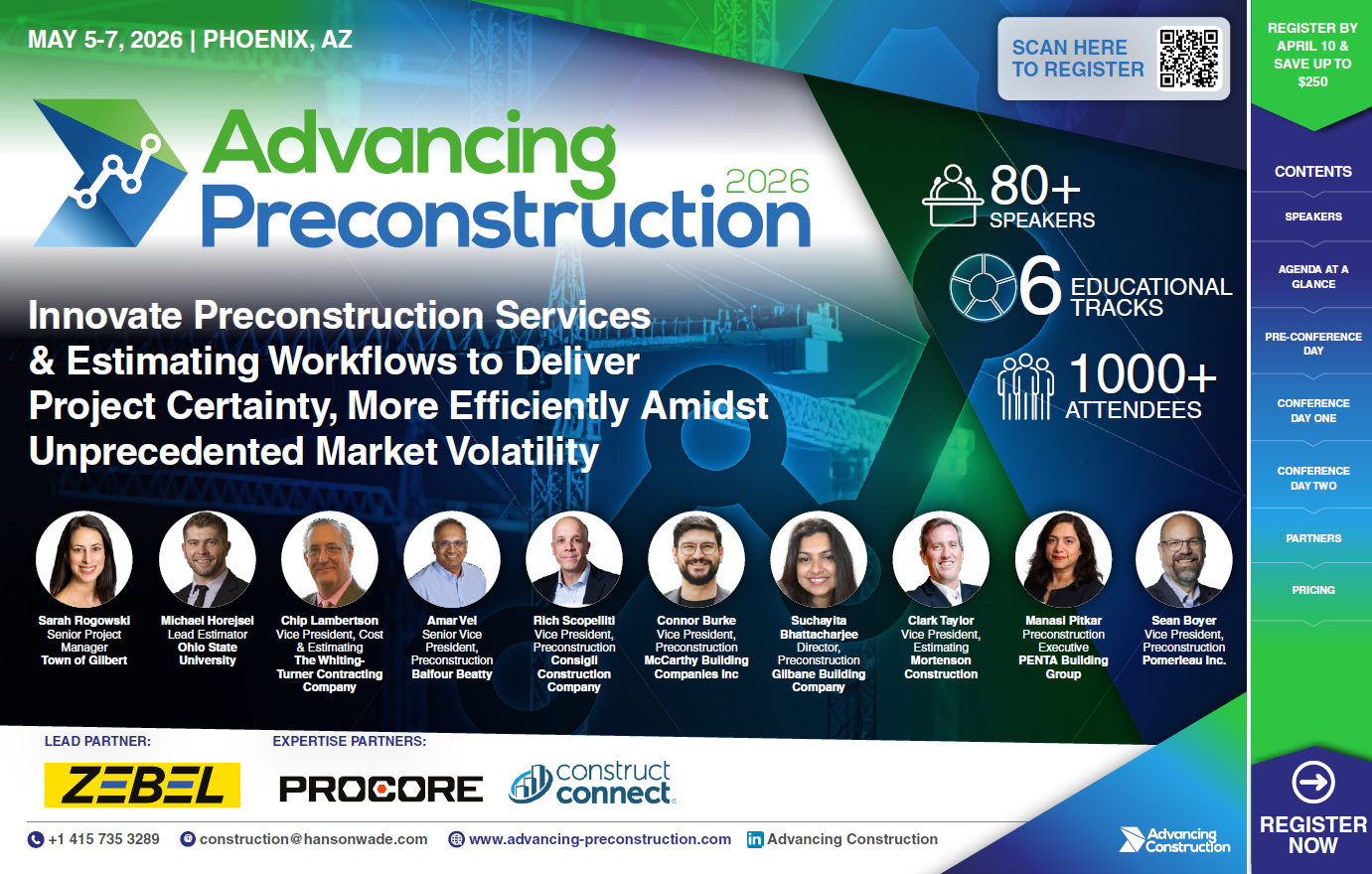
- 80+ speakers from leading GCs, Trades, Clients & Design Firms
- The US’ largest strategic preconstruction conference
- 25% of speakers from Top 30 General & Trade Contractors (ENR)
- Network with 1000+ of the nation’s most dedicated preconstruction leaders
- Brand-new ‘Preconstruction Management’ track to foster strategic innovation across all projects